Consider a single free particle in a three-dimensional box of volume $V$ at temperature $T$, with $\beta = (k_B T)^{-1}$. Its Hamiltonian satisfies
\[\hat H |\mathbf k\rangle = \frac{\hat{\mathbf p}^2}{2m} |\mathbf k\rangle = \frac{\hbar^2 \mathbf k^2}{2m} |\mathbf k\rangle = \varepsilon_{\mathbf k} |\mathbf k\rangle.\]Under periodic boundary conditions, each $\mathbf k$-state occupies a volume $(2\pi)^3/V$ in $\mathbf k$-space, and the position-space wavefunction is
\[\langle \mathbf r | \mathbf k \rangle = \frac{e^{i\mathbf k\cdot\mathbf r}}{\sqrt V}.\]To derive the one-particle partition function $z_1 = V/\Lambda^3$, it is enough to compute the thermal kernel
\[K_\beta(\mathbf r,\mathbf r') = \langle \mathbf r | e^{-\beta \hat H} | \mathbf r' \rangle = \frac{1}{(2\pi)^3} \int e^{-\beta \varepsilon_{\mathbf k}} e^{i\mathbf k\cdot(\mathbf r-\mathbf r')} \, \mathrm d^3\mathbf k.\]Since the exponential factorizes completely in Cartesian coordinates, we only need the one-dimensional integral
\[I(b) = \int_{-\infty}^{+\infty} \exp\left(-a k^2 + i b k\right)\,\mathrm d k, \qquad a = \frac{\beta\hbar^2}{2m}, \quad b = x-x'.\]One subtle point is worth fixing in notation. Here I am working in $\mathbf k$-space, so the Gaussian weight is $e^{-\beta \hbar^2 k^2/(2m)}$ and the Fourier phase is $e^{ik(x-x’)}$. If instead one changes variables to the physical momentum $p=\hbar k$, then the kernel must be written with measure $(2\pi\hbar)^{-3}\,d^3p$ and phase factor $e^{ip(x-x’)/\hbar}$. The two formulations are equivalent, but mixing them is exactly where the thermal-wavelength prefactor is easy to lose.
Completing the square gives
\[I(b) = e^{-b^2/4a} \int_{-\infty}^{+\infty} \exp\left[-a\left(k-\frac{ib}{2a}\right)^2\right]\mathrm d k.\]So the key point is to justify that the Gaussian integral is unchanged by this purely imaginary shift:
\[\int_{-\infty}^{+\infty} \exp\left[-a\left(k-\frac{ib}{2a}\right)^2\right]\mathrm d k = \int_{-\infty}^{+\infty} e^{-a u^2}\,\mathrm d u.\]To prove this, let
\[f(z)=e^{-a z^2}, \qquad z\in\mathbb C,\]which is entire on the whole complex plane. Define $c=-b/(2a)\in\mathbb R$. Then the shifted integral can be written as
\[\int_{-\infty}^{+\infty} \exp\left[-a\left(k-\frac{ib}{2a}\right)^2\right]\mathrm d k = \int_{-\infty}^{+\infty} e^{-a(k+ic)^2}\,\mathrm d k.\]In other words, we are integrating $f(z)$ along the horizontal line $\operatorname{Im} z = c$. Now choose the rectangular contour $C_R$ with vertices
\[-R,\quad R,\quad R+ic,\quad -R+ic,\]oriented counterclockwise, and denote its four sides by $L_1,L_2,L_3,L_4$.
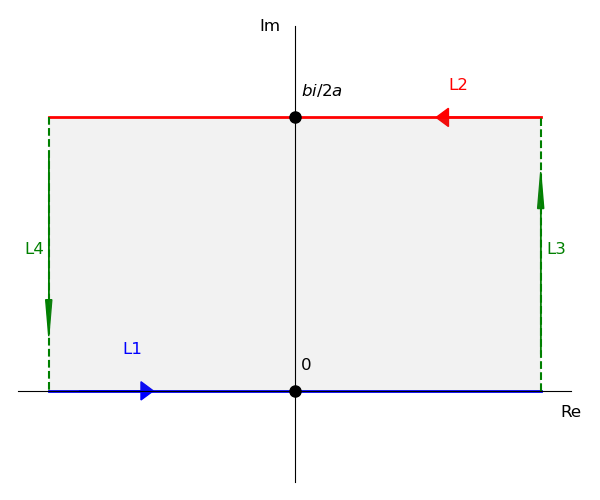
Because $f(z)$ is analytic everywhere, Cauchy’s integral theorem gives
\[\oint_{C_R} f(z)\,\mathrm d z = \int_{L_1} f(z)\,\mathrm d z + \int_{L_2} f(z)\,\mathrm d z + \int_{L_3} f(z)\,\mathrm d z + \int_{L_4} f(z)\,\mathrm d z = 0.\]The two horizontal segments are
\[\int_{L_1} f(z)\,\mathrm d z = \int_{-R}^{R} e^{-a x^2}\,\mathrm d x,\]and
\[\int_{L_3} f(z)\,\mathrm d z = \int_{R+ic}^{-R+ic} e^{-a z^2}\,\mathrm d z = -\int_{-R}^{R} e^{-a(x+ic)^2}\,\mathrm d x.\]It remains to estimate the vertical edges. For $L_2$ we parametrize
\[z=R+isc, \qquad s\in[0,1],\]and similarly for $L_4$. Then, as $R\to\infty$,
\[\left|\int_{L_2} f(z)\,\mathrm d z\right| = \left|\int_0^1 ic\,e^{-a(R+isc)^2}\,\mathrm d s\right| \le |c|\int_0^1 \left|e^{-a(R+isc)^2}\right|\mathrm d s\]and therefore
\[\left|\int_{L_2} f(z)\,\mathrm d z\right| \le |c| \int_0^1 e^{-a(R^2-c^2s^2)}\,\mathrm d s \le |c|\,e^{-a(R^2-c^2)} \longrightarrow 0.\]The same estimate holds for $L_4$. Hence, in the limit $R\to\infty$, only the two horizontal sides survive, and we obtain
\[\int_{-\infty}^{+\infty} e^{-a(x+ic)^2}\,\mathrm d x = \int_{-\infty}^{+\infty} e^{-a x^2}\,\mathrm d x.\]So the plane-wave Gaussian reduces to the ordinary Gaussian:
\[I(b) = e^{-b^2/4a} \int_{-\infty}^{+\infty} e^{-a u^2}\,\mathrm d u = \sqrt{\frac{\pi}{a}}\,e^{-b^2/4a} = \sqrt{\frac{2\pi m}{\beta\hbar^2}} \exp\left(-\frac{m b^2}{2\beta\hbar^2}\right).\]Multiplying the three Cartesian factors together, we arrive at the free-particle heat kernel in coordinate space:
\[K_\beta(\mathbf r,\mathbf r') = \left(\frac{m}{2\pi\beta\hbar^2}\right)^{3/2} \exp\left[ -\frac{m|\mathbf r-\mathbf r'|^2}{2\beta\hbar^2} \right].\]In particular, on the diagonal $\mathbf r=\mathbf r’$,
\[K_\beta(\mathbf r,\mathbf r) = \left(\frac{m}{2\pi\beta\hbar^2}\right)^{3/2}.\]Therefore the single-particle partition function is
\[z_1 = \operatorname{Tr}(e^{-\beta\hat H}) = \int_V K_\beta(\mathbf r,\mathbf r)\,\mathrm d^3\mathbf r = V\left(\frac{m}{2\pi\beta\hbar^2}\right)^{3/2} = \frac{V}{\Lambda^3},\]with thermal wavelength
\[\Lambda = \sqrt{\frac{2\pi\beta\hbar^2}{m}}=\frac{h}{\sqrt{2\pi k_{\rm B}Tm}}.\]