We evaluate
\[I=\int_0^\infty \frac{\arctan x\,\ln(1+x^2)}{x(1+x^2)}\,\mathrm{d}x.\]The integral is convergent. Indeed, its integrand is $O(x^2)$ as $x\to0^+$ and $O(\ln x/x^3)$ as $x\to\infty$.
1. Feynman’s integral method
The general Leibniz integral rule is
\[\frac{\mathrm{d}}{\mathrm{d}t} \int_{\alpha(t)}^{\beta(t)}f(x,t)\,\mathrm{d}x =f(\beta(t),t)\beta'(t)-f(\alpha(t),t)\alpha'(t) +\int_{\alpha(t)}^{\beta(t)}\frac{\partial f}{\partial t}(x,t)\,\mathrm{d}x.\]When the limits are constant, the boundary terms vanish. We obtain the special case commonly called Feynman’s integral method, or differentiation under the integral sign:
\[\frac{\mathrm{d}}{\mathrm{d}t}\int_A^B f(x,t)\,\mathrm{d}x =\int_A^B\frac{\partial f}{\partial t}(x,t)\,\mathrm{d}x.\]This trick is particular useful when dealing with complicated integrands with $\ln f(x)$ and $\arctan f(x)$, as it transforms these terms into rational functions.
To use it here, introduce two parameters:
\[F(a,b)=\int_0^\infty \frac{\arctan(ax)\,\ln(1+bx^2)}{x(1+x^2)}\,\mathrm{d}x, \qquad 0\leq a,b\leq1.\]Clearly,
\[F(0,b)=F(a,0)=0,\qquad I=F(1,1).\]Differentiating first with respect to $a$ and then with respect to $b$ gives
\[\begin{aligned} \frac{\partial^2F}{\partial b\,\partial a}(a,b) &=\int_0^\infty \frac{x^2}{(1+x^2)(1+a^2x^2)(1+bx^2)}\,\mathrm{d}x. \end{aligned}\]Thus the arctangent and logarithm have disappeared, leaving a purely rational integral. For $a,b>0$, the interchange of differentiation and integration is justified on compact subrectangles by domination. Moreover, all the relevant integrands are nonnegative. Applying the fundamental theorem of calculus first on positive parameter rectangles and then using Tonelli’s theorem and monotone convergence as their lower edges tend to zero yields
\[I=\int_0^1\int_0^1 \frac{\partial^2F}{\partial b\,\partial a}(a,b) \,\mathrm{d}b\,\mathrm{d}a.\]Before using complex analysis, make the reciprocal substitution
\[x=\frac1t,\qquad \mathrm{d}x=-\frac{1}{t^2}\,\mathrm{d}t.\]The limits $x=0$ and $x=\infty$ become $t=\infty$ and $t=0$, respectively. Hence
\[\frac{\partial^2F}{\partial b\,\partial a}(a,b) =\int_\infty^0 \frac{t^{-2}}{(1+t^{-2})(1+a^2t^{-2})(1+bt^{-2})} \left(-\frac{1}{t^2}\right)\,\mathrm{d}t=\int_0^\infty \frac{t^2}{(t^2+1)(t^2+a^2)(t^2+b)}\,\mathrm{d}t.\]This puts the rational function into the standard form needed for a semicircular-contour calculation.
2. The rational integral by residues
We first prove the useful identity
\[\int_0^\infty \frac{x^2\,\mathrm{d}x} {(x^2+p^2)(x^2+q^2)(x^2+r^2)} =\frac{\pi}{2(p+q)(q+r)(r+p)}, \qquad p,q,r>0.\]Consider
\[g(z)=\frac{z^2}{(z^2+p^2)(z^2+q^2)(z^2+r^2)}\]on the positively oriented upper-half-plane semicircular contour $C_R$. Recall the Residue Theorem: if $h$ is holomorphic on and inside a positively oriented simple closed contour $C$, except at isolated singularities $z_1,\ldots,z_n$, then
\[\oint_C h(z)\,\mathrm{d}z =2\pi i\sum_{k=1}^n\operatorname{Res}(h,z_k).\]Assume first that $p,q,r$ are positive and pairwise distinct. Factoring the denominator gives
\[g(z)=\frac{z^2} {(z-ip)(z+ip)(z-iq)(z+iq)(z-ir)(z+ir)}.\]The six poles are therefore $\pm ip$, $\pm iq$, and $\pm ir$. Every corresponding linear factor has multiplicity one, so all six are simple poles, or poles of order one. The upper semicircle encloses exactly $ip$, $iq$, and $ir$.
Choose $R>\max(p,q,r)$. The straight segment runs from $-R$ to $R$, and the arc $\gamma_R(\theta)=Re^{i\theta}$, $0\leq\theta\leq\pi$, returns from $R$ to $-R$, giving the contour its counterclockwise orientation.
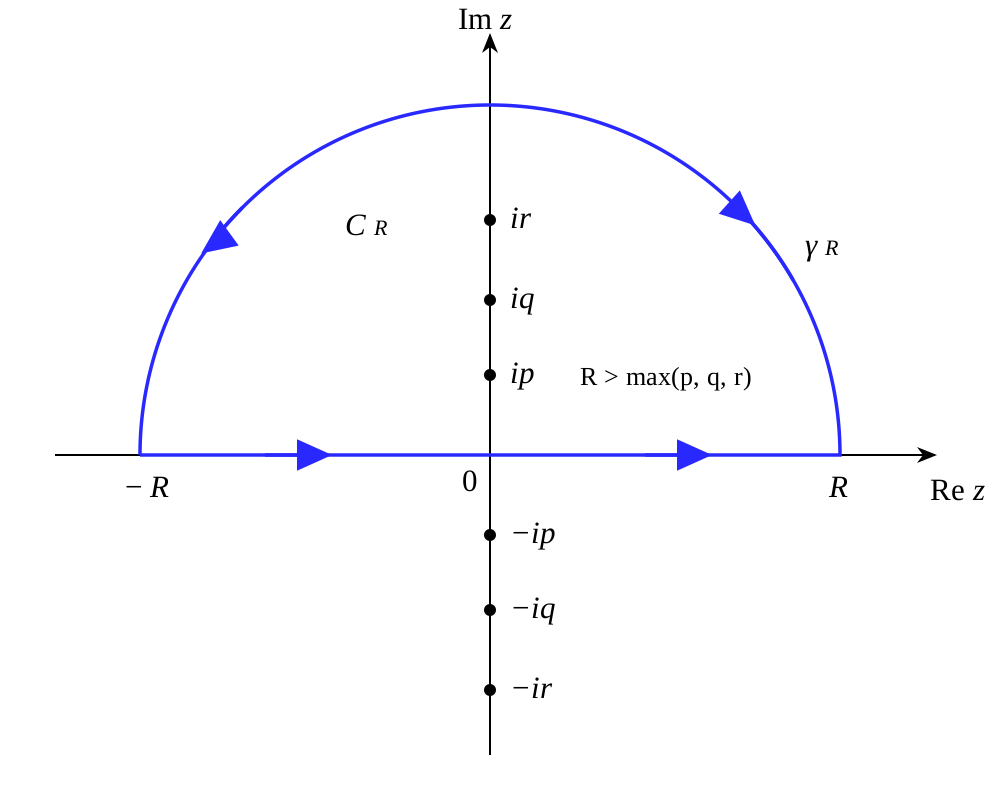
The diagram illustrates $0<p<q<r$; the argument works for any ordering of the three distinct positive parameters.
More generally, if $z_0$ is an isolated singularity of a function $h$, then in some punctured neighborhood of $z_0$ the function has a Laurent expansion
\[h(z)=\sum_{n=-\infty}^{\infty}c_n(z-z_0)^n.\]The residue of $h$ at $z_0$ is, by definition, the coefficient of $(z-z_0)^{-1}$:
\[\operatorname{Res}(h,z_0)=c_{-1}.\]If $z_0$ is a pole of order $m$, the residue can be calculated without writing the entire Laurent series by using the general formula
\[\operatorname{Res}(h,z_0) =\frac{1}{(m-1)!} \lim_{z\to z_0} \frac{\mathrm{d}^{m-1}}{\mathrm{d}z^{m-1}} \left[(z-z_0)^m h(z)\right].\]For $m=1$, no differentiation is required, and this reduces to the simple-pole formula
\[\operatorname{Res}(g,z_0)=\lim_{z\to z_0}(z-z_0)g(z).\]At $z=ip$, cancelling $z-ip$ and then substituting $z=ip$ gives
\[\operatorname{Res}(g,ip) =\lim_{z\to ip} \frac{z^2}{(z+ip)(z^2+q^2)(z^2+r^2)}=\frac{-p^2}{2ip(q^2-p^2)(r^2-p^2)}=\frac{ip}{2(q^2-p^2)(r^2-p^2)}.\]Similarly, the substitutions at $iq$ and $ir$ give
\[\operatorname{Res}(g,iq) =\lim_{z\to iq} \frac{z^2}{(z+iq)(z^2+p^2)(z^2+r^2)}=\frac{(iq)^2}{2iq(p^2-q^2)(r^2-q^2)}=\frac{iq}{2(p^2-q^2)(r^2-q^2)},\] \[\operatorname{Res}(g,ir) =\lim_{z\to ir} \frac{z^2}{(z+ir)(z^2+p^2)(z^2+q^2)}=\frac{(ir)^2}{2ir(p^2-r^2)(q^2-r^2)}=\frac{ir}{2(p^2-r^2)(q^2-r^2)}.\]Since $g(z)=O(|z|^{-4})$, the integral over the large semicircle tends to zero as $R\to\infty$. The Residue Theorem now gives
\[\begin{aligned} \int_{-\infty}^{\infty}g(x)\,\mathrm{d}x &=2\pi i\left[ \operatorname{Res}(g,ip)+\operatorname{Res}(g,iq) +\operatorname{Res}(g,ir) \right]\\ &=-\pi\left[ \frac{p}{(q^2-p^2)(r^2-p^2)} +\frac{q}{(p^2-q^2)(r^2-q^2)} +\frac{r}{(p^2-r^2)(q^2-r^2)} \right]\\ &=\frac{\pi}{(p+q)(q+r)(r+p)}. \end{aligned}\]In the last step, the three rational terms were put over a common denominator and factored. Because $g$ is even, division by $2$ proves the stated identity. Cases in which two or three parameters coincide follow by continuity; in those cases the complex function itself has higher-order poles, but the limiting integral formula remains valid.
Now put $s=\sqrt b$. The rational integral obtained after the reciprocal substitution has the preceding form with $p=1$, $q=a$, and $r=s$. Consequently,
\[\frac{\partial^2F}{\partial b\,\partial a}(a,b)=\frac{\pi}{2(1+a)(a+\sqrt b)(1+\sqrt b)}.\]3. Recovering the original integral as a double integral
Substituting the last result and then setting $b=s^2$, so that $\mathrm{d}b=2s\,\mathrm{d}s$, we obtain
\[I =\frac{\pi}{2}\int_0^1\int_0^1 \frac{\mathrm{d}b\,\mathrm{d}a} {(1+a)(a+\sqrt b)(1+\sqrt b)}=\pi\int_0^1\int_0^1 \frac{s}{(1+a)(a+s)(1+s)}\,\mathrm{d}s\,\mathrm{d}a.\]Denote the last double integral without the factor $\pi$ by $D$. The square $[0,1]^2$ is symmetric under $a\leftrightarrow s$. Hence
\[D=\int_0^1\int_0^1 \frac{a}{(1+a)(a+s)(1+s)}\,\mathrm{d}s\,\mathrm{d}a.\]Adding this expression to the original one for $D$ gives
\[2D =\int_0^1\int_0^1 \frac{a+s}{(1+a)(a+s)(1+s)}\,\mathrm{d}s\,\mathrm{d}a =\int_0^1\int_0^1 \frac{1}{(1+a)(1+s)}\,\mathrm{d}s\,\mathrm{d}a =\left(\int_0^1\frac{\mathrm{d}u}{1+u}\right)^2 =\ln^2 2.\]Finally, we get
\[\int_0^\infty \frac{\arctan x\,\ln(1+x^2)}{x(1+x^2)}\,\mathrm{d}x =\frac{\pi}{2}\ln^2 2.\]